
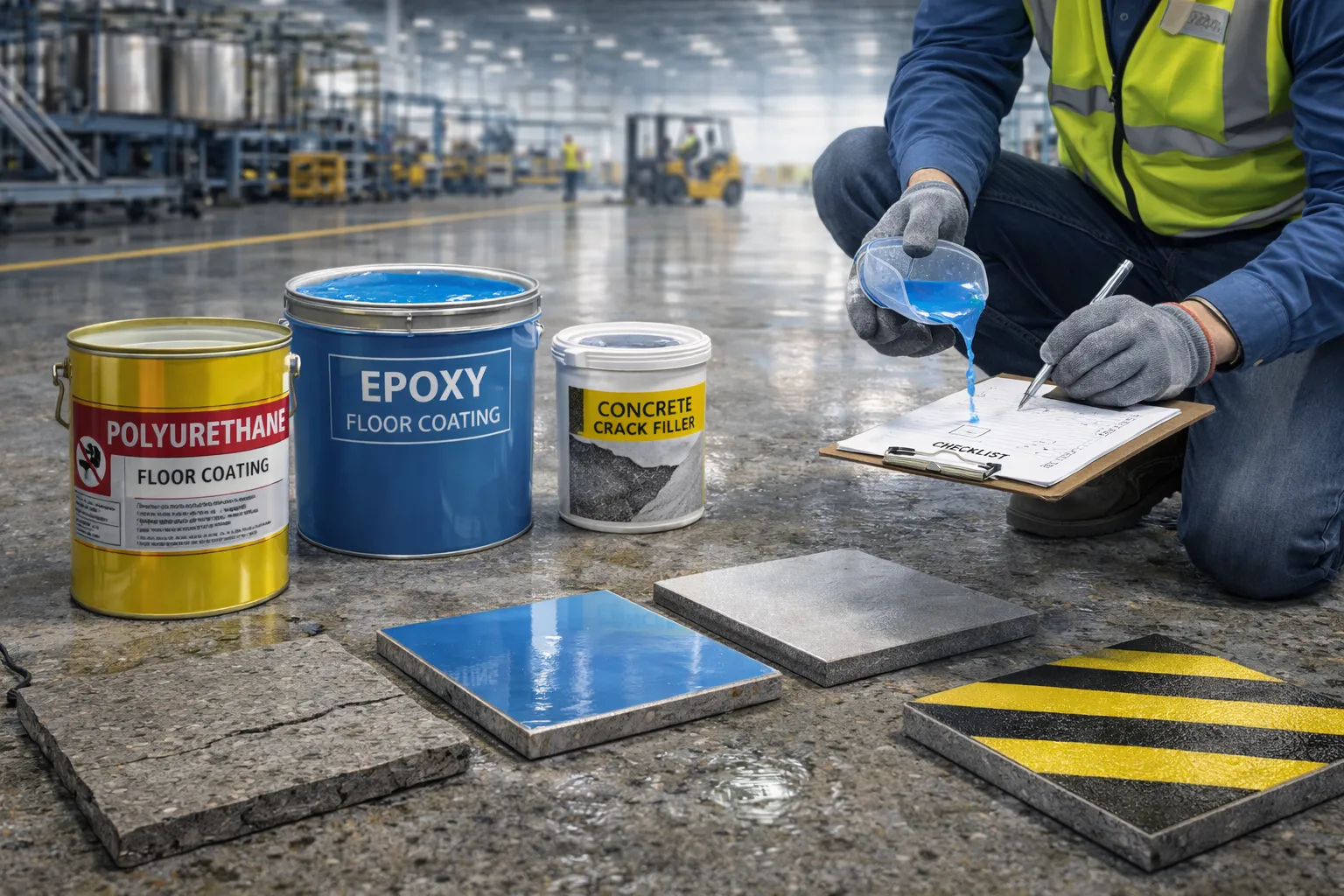
Selecting an industrial flooring system
Answer the questions — and an engineer will quickly narrow the choice to 1–3 suitable systems for your conditions and timeline.
Why “just a 2 mm self-leveling floor” is a bad technical brief
In industrial facilities, the details matter: loads, wheel type, chemicals, concrete moisture, thermal shock, and the cleaning regime. If something is overlooked, the coating can start dusting, become slippery, blister, or delaminate — and you’ll end up with downtime and repairs.
This checklist helps you collect the input data for an engineer. If you answer at least 7–8 questions, that’s already enough for a preliminary selection. If you answer all 12, you can move on to a more precise specification of layers and materials.
- Loads and traffic: weight, wheels, turns, impacts, racking.
- Chemicals: substance, concentration, and contact time.
- Substrate moisture: new slab, moisture rising from below, presence of waterproofing.
- Temperatures and thermal shock: hot washdown, steam, sudden swings.
- Commissioning time: when you can walk and drive equipment.
- Slip resistance and cleaning: the balance between safety and ease of cleaning.
You can fill out the brief, review systems, or see industry solutions — this will speed up the discussion.
Engineer’s checklist: 12 questions before choosing a system
There are no “right” answers here — there are conditions that lead to different technologies. Answer briefly: numbers, lists, “I don’t know” — that’s also an answer.
-
1Facility type and areas
- warehouse / manufacturing / food processing / parking garage, etc.;
- which areas differ in conditions (wet/dry, heavy traffic, ramps, washdown, cold room).
-
2Loads and vehicles
- forklifts/pallet jacks: weight, speed, wheel type (polyurethane/rubber, etc.);
- racking: load per support, impact zones, possible dropped loads.
-
3Time to put into service
- when foot traffic is allowed;
- when full load is allowed (equipment/racking);
- whether there is a “window” overnight/on weekends.
-
4Operating schedule
- 1–3 shifts, 5/2, or 24/7;
- can areas be closed off in sequence (phased work).
-
5Temperatures, swings, and thermal shock
- minimum and maximum temperature;
- is there hot washdown/steam/thermal shock;
- are there refrigerated/freezer areas.
-
6Chemical exposure
- what exactly gets on the floor (acids/alkalis/oils/solvents/salts);
- concentration and contact time;
- is it occasional spills or a continuous environment.
-
7Substrate moisture and waterproofing
- new concrete or renovation;
- do you know whether there is waterproofing/a membrane under the slab;
- have you measured moisture, and were there “bubbles/blistering” before.
-
8Condition of the concrete
- strength, wear, dusting;
- cracks/potholes/chips, condition of joints;
- are there oil contamination or unknown sealers/paints.
-
9Cleaning and wet areas
- how you clean: by hand/machine/pressure washing;
- which detergents and how often;
- how quickly the floor dries (ventilation/drains).
-
10Slip resistance and texture
- pedestrian area or vehicle traffic area;
- is there water/oil;
- do you need a specific R rating.
-
11Special requirements
- antistatic/ESD, “clean” areas, hygiene requirements;
- constraints on odor and working hours;
- marking, color, appearance requirements.
-
12Expected service life and budget approach
- what matters more: price per m², commissioning time, or service life;
- is phased repair without a full shutdown acceptable;
- what’s the logic: “minimum now” or “longer without downtime”.
- Plan/sketch (even hand-drawn) + area and zones.
- Photos/video of the floor: overall view + defects (cracks, joints, potholes).
- Loads: equipment/wheels/racking/impacts.
- Commissioning date: when the facility must be operational.
- Cleaning: how you wash, with what, how often, whether there is hot washdown/steam.
- Chemicals: list of substances/detergents, concentrations, contact time.
- Temperatures: min/max, whether there is thermal shock, refrigerated areas.
- Moisture (if measured) + information about waterproofing.
- Spec/project (PDF), if available.