
A warehouse floor is not “finishing” — it is part of the logistics infrastructure. A mistake in one detail (for example, in turns or at joint edges) quickly turns into repairs, equipment downtime, and constant cleaning. Below is a clear logic of what exactly destroys a floor and how to choose a system: impregnation (dustproofing), topping or epoxy.
We supply materials and help select a system for your loads and operating mode. The works are performed by your contractor, and we involve a technologist and support the solution on site.
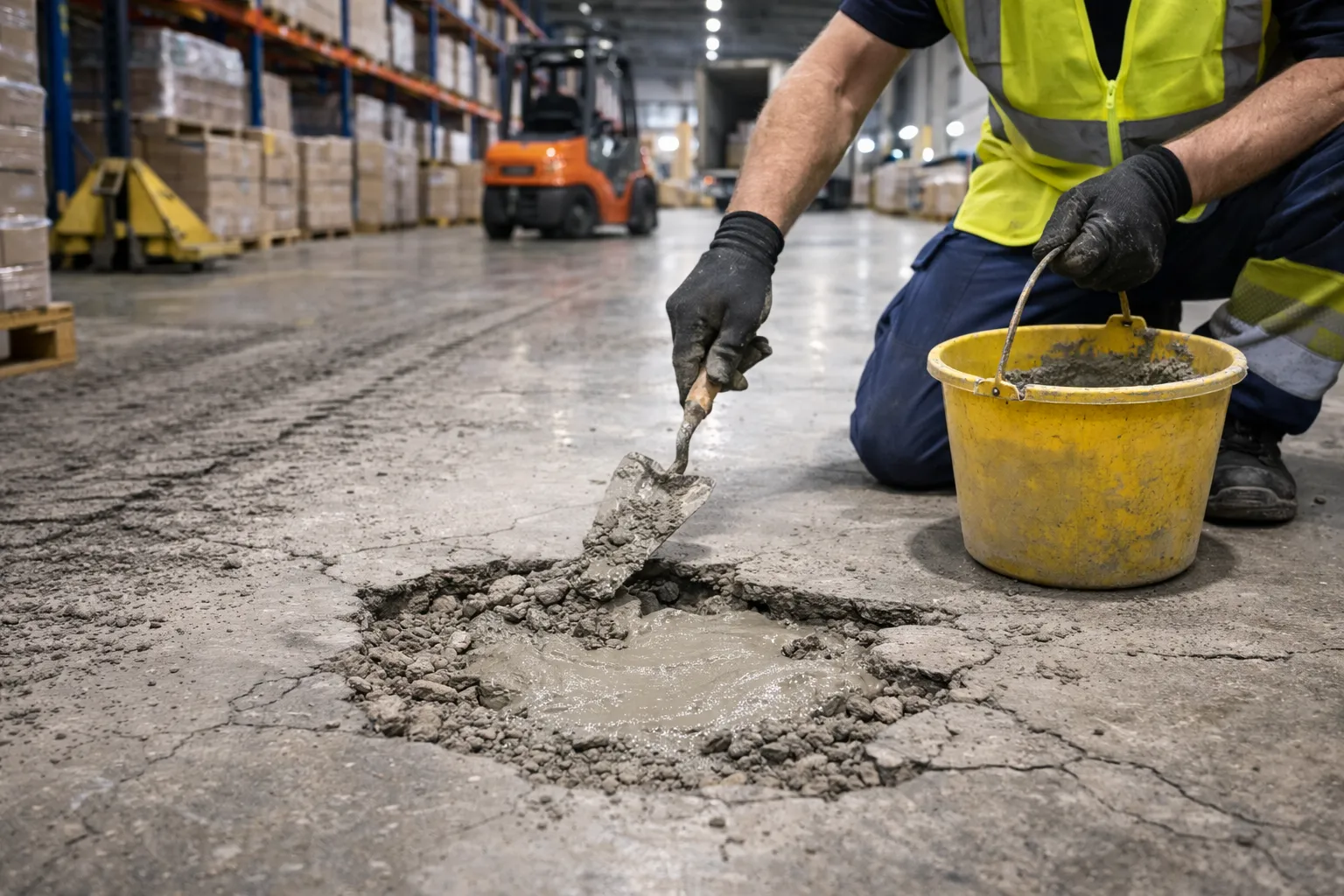
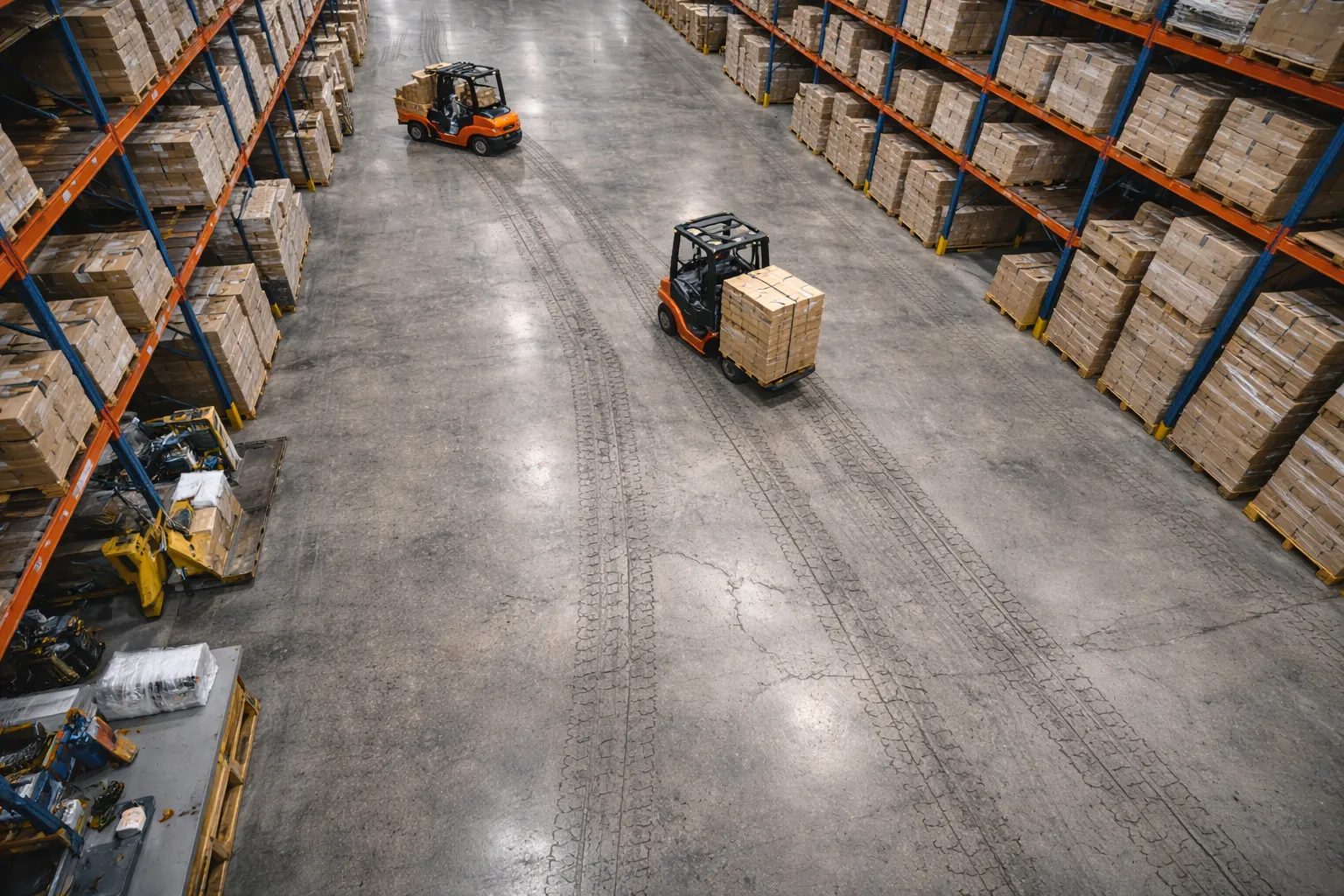
In warehouses, people often want “one wear-resistant floor for the entire facility”. In practice, a warehouse is a set of zones with different dynamics: straight aisles, turns, docks, gates, racking rows. If you do not separate loads by zones, you will almost certainly get one of three scenarios: dust (dirt, risks for goods and equipment), wheel ruts (equipment starts to “pound”, wheel and suspension wear increases), spalls (especially at joints and gates, where there is a lot of impact and shear).
- Dust — a weak concrete surface layer + abrasive (sand/dust) + improper cleaning / early commissioning.
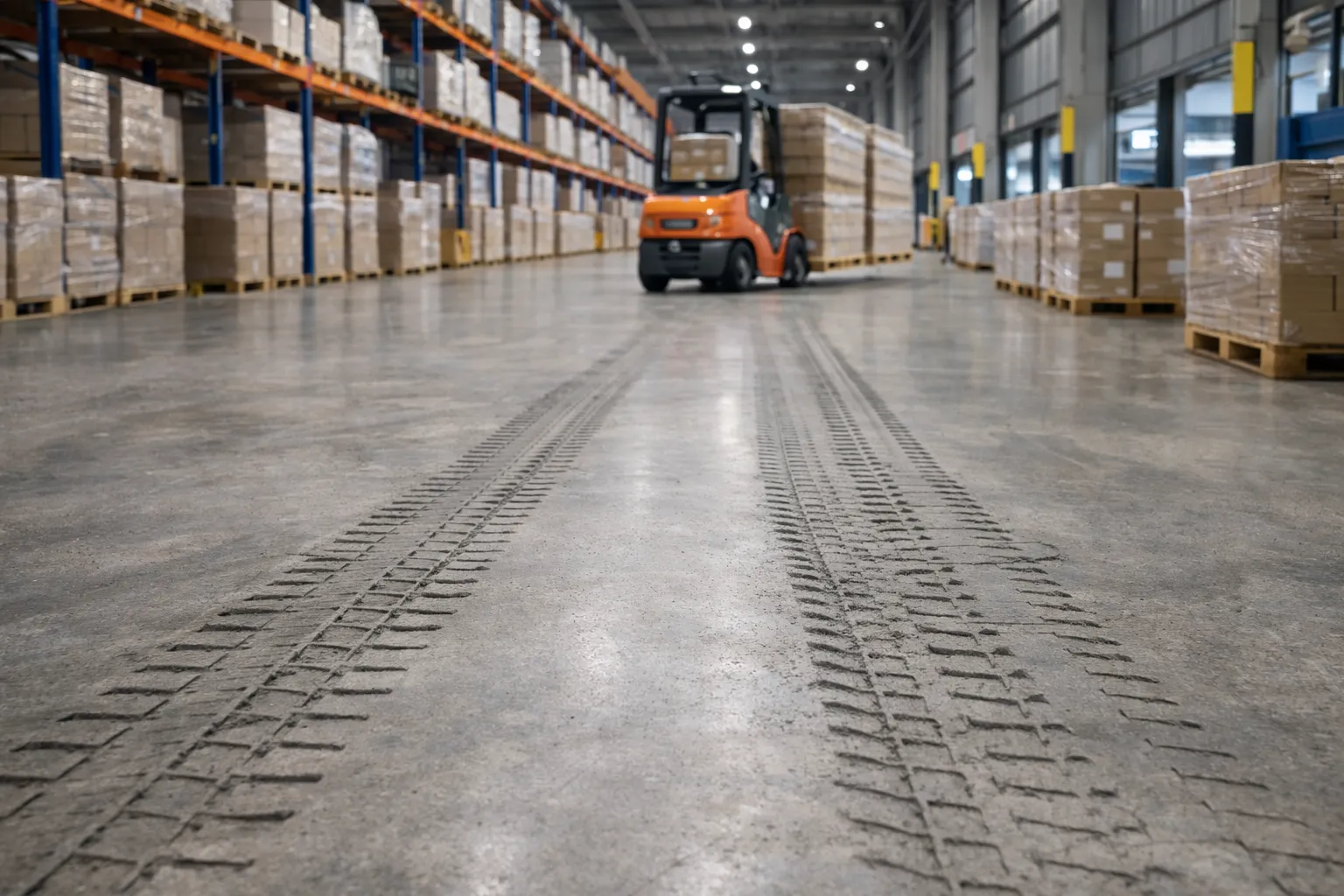
- Wheel ruts — high contact pressure from wheels + “shear” in turns + a weak surface.
- Spalls — wheel impact on the joint edge + a damaged/empty joint + a weak edge.
1) Why a floor “on paper” lasts less
Most often, it is not that the “material is bad”, but a combination of factors: a weak substrate, poorly planned routes, joints without protection, abrasive brought in from outside, and cleaning that does not match the system. Even a very good coating will not help if the basic details are executed incorrectly.
Three common causes
- A weak concrete surface layer. Dust appears if “cement laitance” remains on the surface, the concrete was not kept in a moist curing regime, or operation started too early. The result is that the top layer grinds into a fine fraction and constantly rises into the air.
- Shear in turns and braking zones. On straight sections, the load is mainly rolling. In 90°/180° turns, in narrow aisles, and at gates, a strong horizontal component appears: the wheel literally scrapes the surface — hence wheel ruts and spalling.
- Joints without an engineering approach. The joint edge is the most vulnerable place. If the joint is empty or filled incorrectly, the wheel hits the edge like a hammer — and small chips quickly turn into spalls.
2) Forklift loads: where the floor wears out fastest
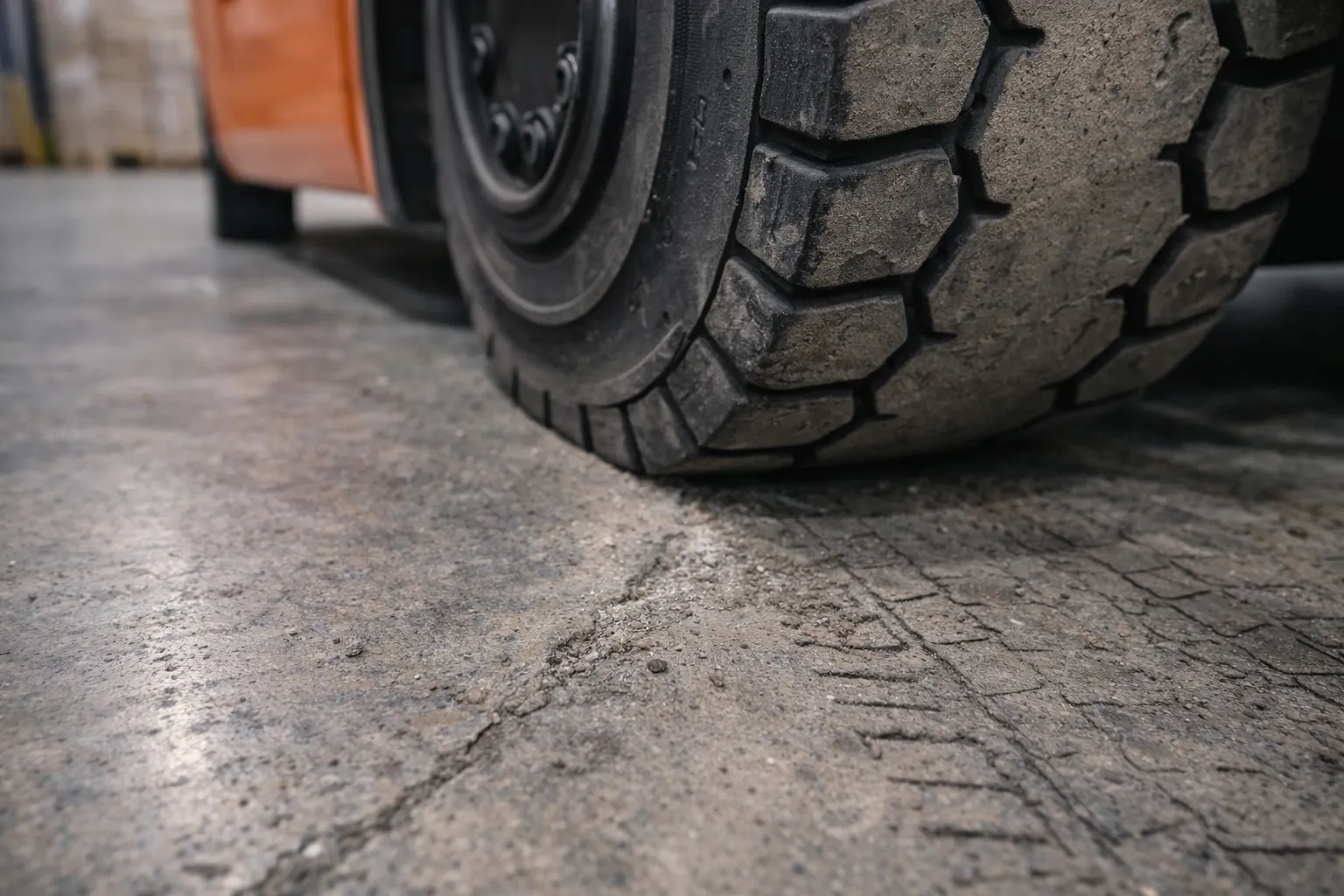
The main destroyer of warehouse floors is wheeled equipment: forklifts, stackers, reach trucks, pallet jacks. The contact area of a wheel is small, so the pressure on the surface is very high. And in turns and during pivoting, shear is added — it is what forms wheel ruts and spalling.
What to clarify before choosing a system
- Maximum “equipment + load” weight (gross weight matters, not “empty machine”).
- Wheel type (polyurethane/rubber/nylon). Hard wheels increase contact pressure.
- Traffic intensity (shifts, peaks, “bottlenecks”).
- Route geometry: where braking happens, where turning happens, where there is diagonal shear.
- Abrasive: sand from outside and fine debris dramatically accelerate wear.
3) Joints and edges: how to avoid spalls
Joints in warehouses are inevitable: concrete moves, shrinks, and has temperature deformations. The problem is not that the joint exists, but that it is treated as an afterthought. In reality, a joint is a detail that must be designed for wheeled loads and maintained.
3 rules that reduce repair costs
- Joints aligned with logistics. The joint plan is coordinated with equipment routes: whenever possible, do not place joints on the most heavily loaded trajectories.
- The edge must be protected. For warehouses, “live” edges without chips are important — solutions for protecting details are used (including edge reinforcement/profiles).
- Joint filler is a consumable. It must be checked and renewed per schedule, otherwise edge spalling will begin.
- • route map and turning zones;
- • joint plan and “detail map” (gates, docks, turns);
- • requirements for base strength and flatness;
- • requirements for joint maintenance during operation.
- • regular joint inspection (especially at gates and in turns);
- • replace filler before edge failure;
- • abrasive control (sand at gates accelerates wear);
- • repair small chips immediately, before they become a spall.
4) Marking: how to make it last
Warehouse line marking is safety and speed. A classic mistake is to apply ordinary paint “like on asphalt” and be surprised that after a couple of months there is almost nothing left. Marking must be designed together with the coating and must consider how you clean and which zones have maximum shear.
Practical approaches
- On concrete after impregnation: two-component marking over a dust-free surface + reinforcement in the most heavily loaded areas.
- On an epoxy system: marking as a separate layer (or as part of the finish) — the most predictable option by service life.
- On new concrete with topping: marking after the concrete has gained strength + proper preparation (no dust) and selecting the material for the intensity.
- • dustproofing/priming before application;
- • observing strength gain and curing times;
- • reducing abrasive at gates (dirt-control zones);
- • renewal schedule and a “repair kit” in stock.
- • applying to a dusty surface (“paint on sand”);
- • no degreasing in oil and tire zones;
- • cutting corners in turns and at gates;
- • harsh abrasive cleaning without the proper regimen.
5) Repairability: so the warehouse does not shut down
Warehouses operate in a “needed yesterday” mode, so it is not only strength that matters, but also repairability: the ability to restore a detail locally (a turn, a gate, a joint) without stopping the entire facility.
How to design for repairability in advance
- Divide the warehouse into wear zones and choose a system not “for the entire facility”, but for a specific zone.
- Keep a minimum set of materials for quick repair: repair compounds, joint materials, and marking materials.
- Inspect on a schedule: a small chip today is cheaper than a “map of spalls” in six months.
If the warehouse operates 24/7, agree in advance: which repairs can be done at night, how long it takes until “light traffic” and until full load. This should be a system selection criterion, not “we will figure it out later”.
6) Quick selection: impregnation / topping / epoxy
For most warehouses, the choice comes down to three solutions. They differ by when they are applied (new concrete or existing), how much they deliver for cleanliness/wear, and which risks they cover.

Reduces dusting and increases the wear resistance of concrete, practically does not change floor levels and is often done quickly. But it does not fix a weak substrate and “killed” joints — they must be repaired separately.

Cost-effective surface hardening for high wheeled loads. Works great on straight routes and logistics details, but heavily depends on the quality of concreting, curing, and joints.

A seamless surface, easier to maintain cleanliness, convenient for durable marking and color zoning. It is important to follow substrate preparation and moisture requirements.
| Comparison | Impregnation | Topping | Epoxy |
|---|---|---|---|
| When it is suitable | Concrete already exists and is generally “sound” | Only on fresh concrete | On cured concrete after preparation |
| Cleanliness / dust | Greatly reduces dusting | Hardens the top layer | The “cleanest” surface |
| Wheel ruts and wear | Good under medium loads and with strong concrete | Excellent under high wheeled loads | Good with proper system selection |
| Joints | Joints are repaired and maintained separately | Joint quality is critical | Joints remain a detail: execution and schedule matter |
| Marking | Possible with good preparation (dust-free) | After the concrete has gained strength | Best for service life |
FAQ
Brief and to the point — answers to common questions.
Can you just paint concrete so it does not dust?
You can, but in a warehouse paint often does not last long without proper preparation. If the task is to remove dust and strengthen the top layer, it is usually reasonable to start with impregnation (dustproofing) . If you also need easy cleaning and stable marking — look toward epoxy systems.
Why do spalls appear specifically at joints?
Because the wheel regularly hits the edge — especially when the joint is empty or the filler has failed. Vibration + impact quickly “break” the edge, and a spall appears. The fix is the right joint detail and a maintenance schedule.
Which warehouse system is the most “durable”?
There is no universal answer: service life depends on the zone and operating mode. For a new warehouse with heavy equipment, people often choose topping , for existing concrete — impregnation or epoxy . The right question is: “which system covers the risks of a specific zone”.
Do you need to make the floor completely seamless?
Seamlessness matters primarily for cleaning and sanitary requirements. But the slab’s control joints still remain a detail that must be executed and maintained properly.
How do you know whether your concrete is suitable for a coating?
At minimum, assess strength/flatness/moisture and the condition of the joints. If you have doubts — fill out the questionnaire and attach photos/plan. We will advise where impregnation is sufficient, and where base repair or a more “heavy-duty” system is needed.
Attach photos/plan — that way we can recommend the optimal system for your zone faster.