Lincrete® AS ECF (3–6) is a chemically resistant conductive polyurethane–cement flooring system for protecting concrete substrates (floors) in food, pharmaceutical, chemical and petrochemical production facilities.
Lincrete® AS ECF (3–6) is a modified self-leveling four-component polyurethane–cement system that provides a durable floor:
-
conductive, with electrical resistance low enough to ensure rapid charge dissipation in the presence of grounding or connection to a lower potential point;
-
meeting sanitary and epidemiological requirements;
-
having a long service life;
-
resistant to chemical exposure, blood and fats, lactic acids, oils and fuels and lubricants;
-
resistant to commonly used disinfectants and cleaning agents.
Key material features:
Fast and simple application
Lincrete® AS ECF (3–6) flooring is suitable not only in terms of conductive, chemical and mechanical performance for food, chemical, petrochemical and pharmaceutical facilities, but also in terms of installation conditions.
The mixed material is poured onto the substrate and spread with a notched trowel with pin spacers. Immediately after spreading, the surface must be treated with a spike roller. Spiked shoes must be used to move over the fresh material.
There is no need to completely stop production on an operating site or in a production area, since the coating gains strength quickly and the floor can be walked on after 12 hours at 20°C. Full pedestrian loading is recommended after 24 hours, and traffic loading after 72 hours.
Resistant to high temperatures
The coating does not suffer damage either in service or during steam cleaning under extreme temperature conditions. The material can be applied at different thicknesses — 3 or 6 mm, depending on the expected loads:
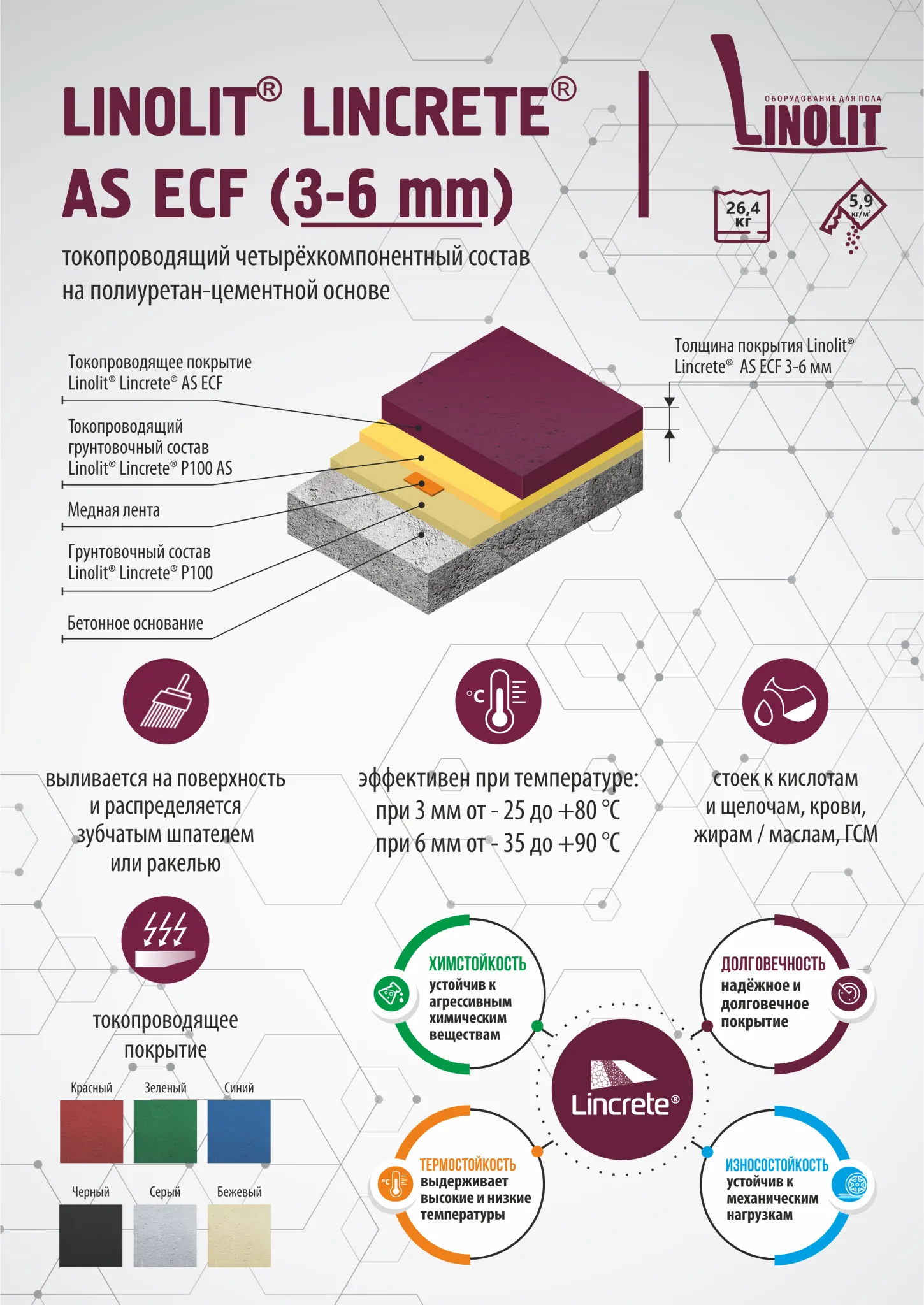
- at 3 mm thickness the coating is not damaged in service or during cleaning at temperatures from −25°C to +80°C;
- at 6 mm thickness the coating is resistant to temperatures from −35°C to +90°C.
Odorless
Non-combustible
High resistance to abrasive wear
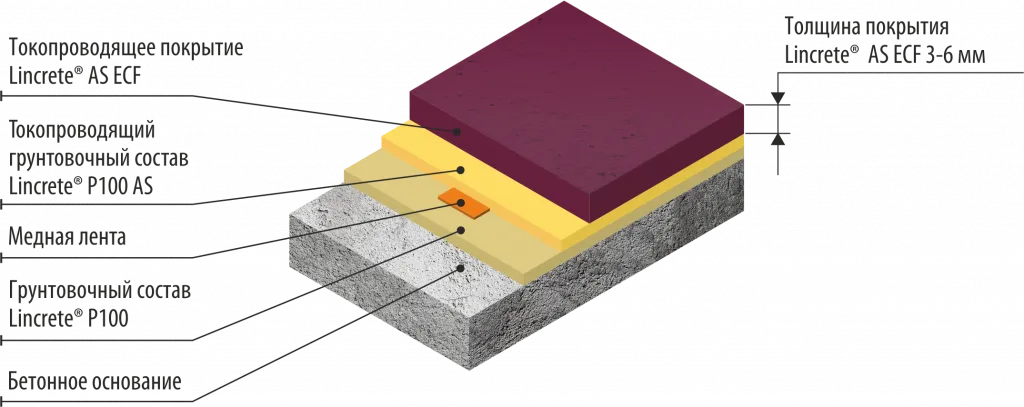
Coating thickness: 3–6 mm.
Colored system (available in 7 standard colors).
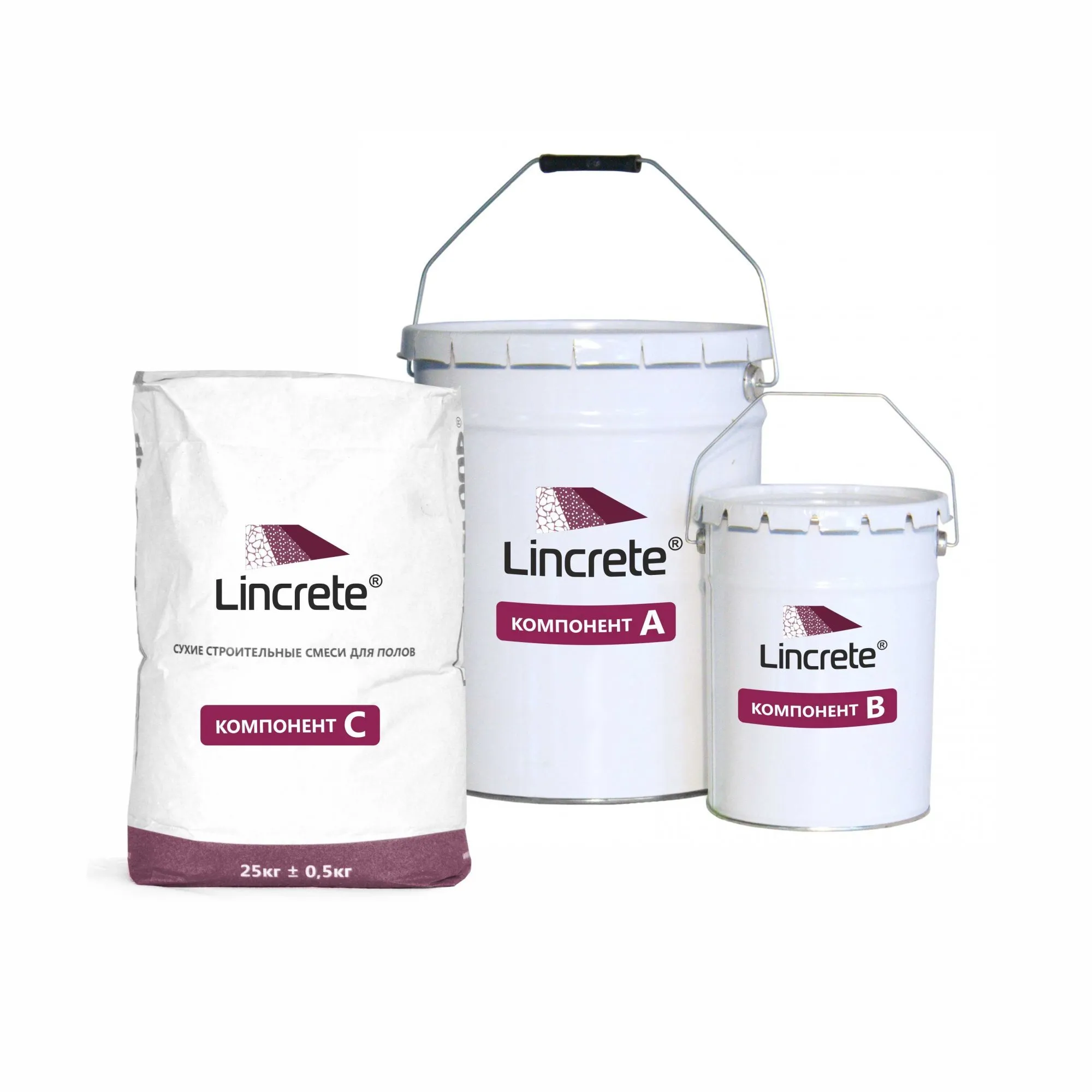
Kit composition:
- component A (binder) — 5 kg (5 L canister);
- component B (hardener) — 5.1 kg (5 L canister);
- component C (filler) — 16 kg (paper bag);
- pigment paste — 0.315 kg (pail).
Kit mass: 26.415 kg.
Chemical resistance
Chemical resistance table for Lincrete® AS ECF (3–6) according to DIN EN 13529 (95/1999). The table shows resistance after 1 day of continuous exposure of the spilled substance on the specimen surface.
Chemical spills must be removed as quickly as possible and the flooring surface cleaned. The longer the exposure, the more severe the damage to the coating. The substances were tested at room temperature; higher operating temperatures can accelerate coating degradation under spills. Changes in color and gloss generally do not indicate a loss of mechanical strength.
| Chemical |
Test group |
Chemical |
Test group |
Chemical |
Test group |
| Nickel sulfate (20%) |
A |
Potassium bromide (24%) |
A |
Sodium hydrogen phosphate |
A |
| Nitric acid (<10%) |
A/D |
Potassium carbonate (30%) |
A |
Sodium bisulfate (23%) |
A/D |
| Nitric acid (30%) |
A/D |
Potassium chloride (20%) |
A |
Sodium bisulfite (50%) |
A/D |
| Nitrobenzene |
A |
Potassium cyanide (20%) |
A |
Sodium hydroxide (20%) |
A/D |
| 2-nitropropane |
A |
Potassium fluoride (30%) |
A |
Sodium iodide (20%) |
A |
| Solvent for nitro paints |
A |
Potassium hexacyanoferrate (II) |
A |
Sodium nitrate (20%) |
A |
| Nitrotoluene |
A |
Potassium bisulfate (20%) |
A |
Sodium nitride (20%) |
A |
| N-methylpyrrolidone |
A |
Potassium hydroxide (20%) |
A/D |
Sodium phosphate (20%) |
A/D |
| n-octane |
A |
Potassium iodide (20%) |
A |
Sodium silicate (20%) |
A/D |
| n-propyl acetate |
A |
Potassium nitrate (20%) |
A |
Sodium sulfate (20%) |
A |
| n-propanol |
A |
Potassium phosphate (20%) |
A |
Sodium sulfide (20%) |
A/D |
| Oleic acid |
A |
Sodium hydroxide (20%) |
A |
Sodium tetraborate (borax) (20%) |
A/D |
| Oxalic acid solution (10%) |
A/D |
Propionic acid (10%) |
A/D |
Sodium thiosulfate (20%) |
A |
| Citric acid solution (23%) |
A/D |
Propionic acid 99% |
C |
Soy lecithin |
A/D |
| Pentane |
A |
Propylene glycol |
A |
Petroleum ligroin naphtha |
A/D |
| Perchloroethylene |
B/D |
Salicylic acid (10%) |
A/D |
Styrene |
A/D |
| Gasoline |
A/D |
Seawater |
A |
Sulfuric acid >20% |
B/D |
| Crude oil |
A |
Brake fluid |
A |
Sulfuric acid 60% |
C |
| Phenol |
A |
Soap solution 5% |
A |
Tall oil |
A |
| Phosphoropropionic acid |
C |
Sodium hydroxide (>20%) |
A/D |
Tannic acid (10%)* |
A/D |
| Phosphoric acid (20%) |
A/D |
Saturated sodium sulfide solution 17% |
A |
Surfactants |
A |
| Phosphoric acid 40% |
A/D |
Sodium acetate (20%) |
A |
Tetrahydrofuran (THF) |
B/D |
| Phosphorus chloride |
A/D |
Sodium aluminum sulfate (20%) |
A |
Toluene |
A/D |
| Diethyl phthalate |
A/D |
Sodium bromide (20%) |
A |
Trichlorobenzene |
B/D |
| Plasticizer (phthalate) |
A/D |
Sodium carbonate (20%) |
A |
Trichloroethane |
B/D |
| Polyhydric alcohols (polyols) |
A/D |
Sodium chloride (20%) |
A |
Trichloroethylene |
B/D |
| Polychlorinated biphenyl |
B/D |
Sodium cyanide (20%) |
A |
Chloroform |
C |
| Simple polyester |
A/D |
Sodium dihydrogen phosphate (20%) |
A |
Trichlorophenol |
C |
| Polyethylene glycol |
A |
Fluorinated sodium acetate |
A |
Triethanolamine (98%) |
A/D |
| Potassium aluminum sulfate (30%) |
A |
Sodium fluoride |
A |
Triethylamine (99%) |
A/D |
| Potassium bicarbonate (22%) |
A |
Sodium hexafluorosilicate |
A |
Triethylenetetramine (TETA) |
A/D |
| Potassium borate (31%) |
A |
Sodium bicarbonate |
A |
Triethylene glycol |
A |