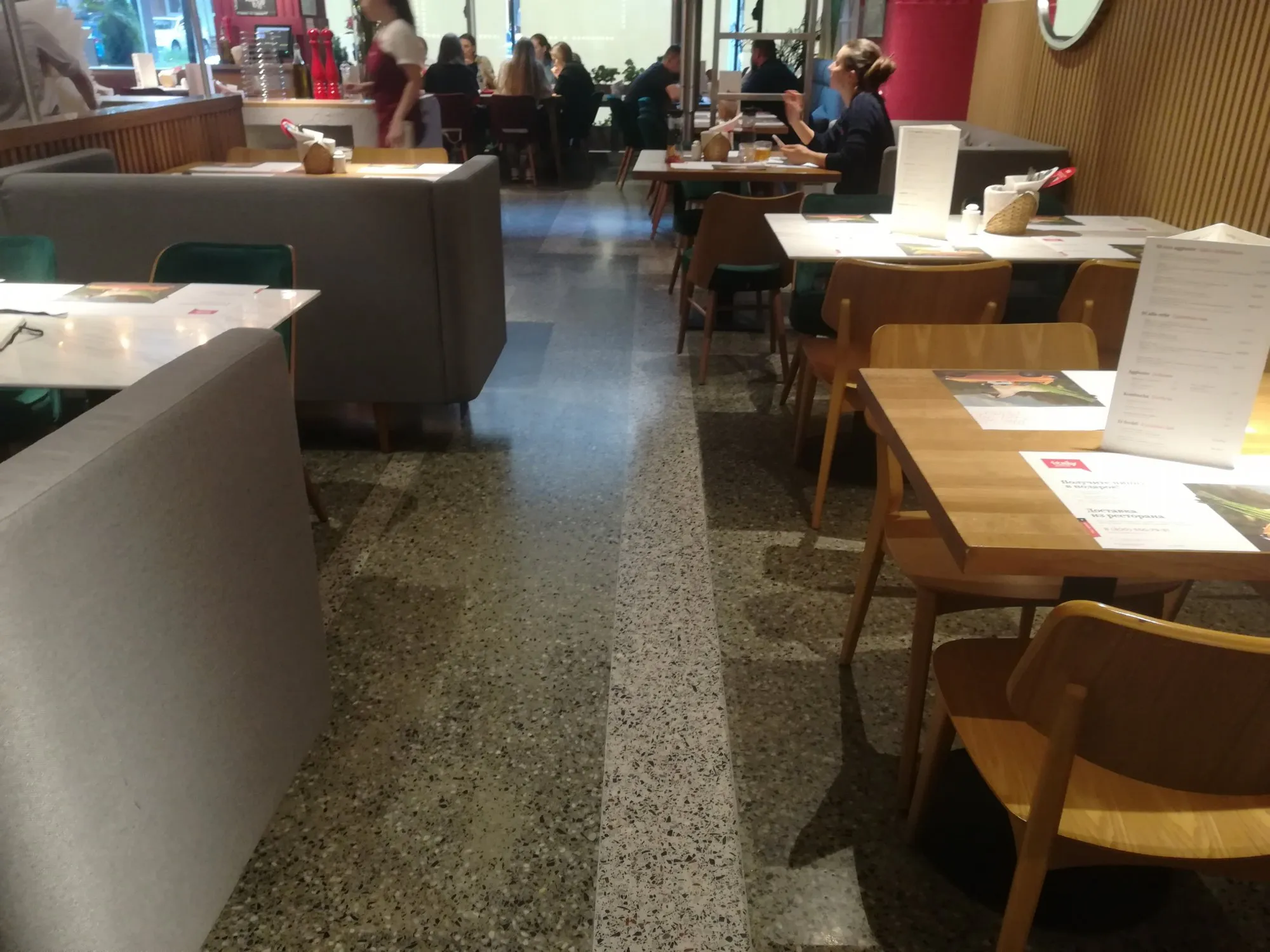
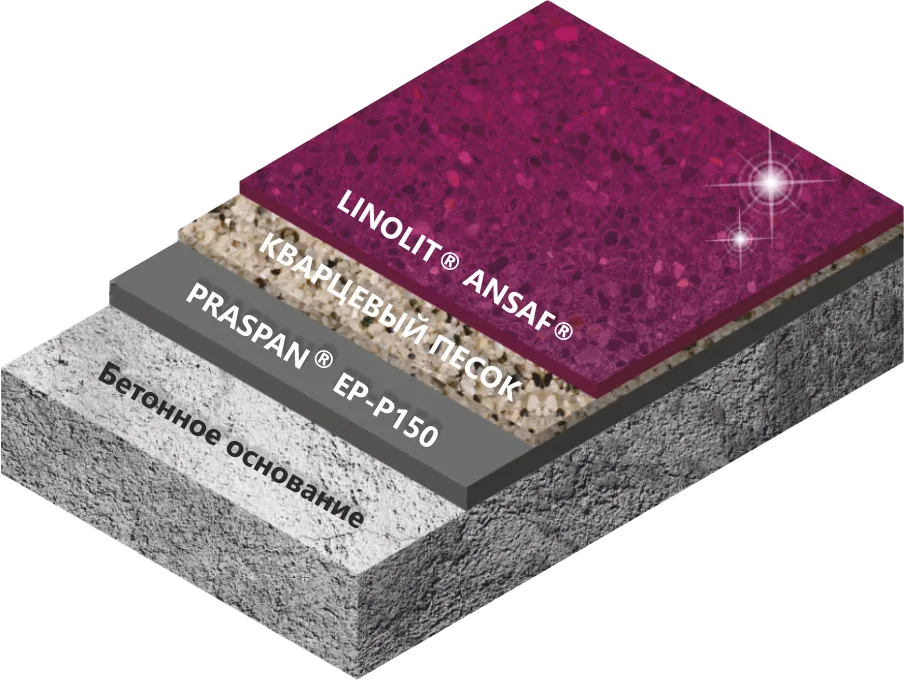
Linolit® Ansaf® is a cement-based coating with mineral and synthetic aggregates: black or white marble, jasper, river or sea pebbles, crushed shells, glass, granite, and more. Aggregate size can reach 20 mm. Coating thickness ranges from 10 to 30 mm. The coating imparts an elegant look with natural pastel tones. It can be used under medium to heavy floor loads; compressive strength is min. 50 MPa.
Linolit® Ansaf® is a durable coating with excellent decorative properties, ideal for use in:
- malls and shopping and entertainment centers,
- lobbies of business centers and offices,
- showrooms and boutiques,
- cafés and restaurants,
- theaters and cinemas,
- exhibition centers.
- Ansaf® floors are high-strength decorative floors, resistant to abrasion and impact, repairable, and easy to keep clean.
- Ansaf® floors can be monolithic or patterned per a specified template (stencil).
- Ansaf® floors are available with various mineral or synthetic aggregates.
- To enhance aesthetics and achieve the desired gloss, the finished floor is ground and polished with Linolit® machines and chemicals.
Technical characteristics
| Layer thickness |
from 10 mm |
| Bulk density of the mix |
2500 kg/m³ |
| Strength development time |
28 days |
| Foot traffic |
after 24 hours |
| Light load (up to 200 kg/cm²) |
after 7 days |
| Compressive strength after 28 days |
min. 50 MPa |
| Flexural tensile strength after 28 days |
min. 5 MPa |
| Impact resistance |
20 kg/mm² |
| Shrinkage |
max. 0,09% |
| Maximum particle size of the dry mix |
5 mm |
| Abrasion class by BCA method (EN 13892-4) |
AR 0.5 |
Note:
for Linolit® Ansaf® “natural,” gray cement is used;
for Linolit® Ansaf® “colored,” white cement is used.
Certification and testing
- The material complies with TU 23.64.10-001-09031640-2017.
- The material meets sanitary and hygienic requirements for products subject to sanitary supervision (Section 11), as approved by the Customs Union Commission Decision No. 299 of May 28, 2010.
- The material complies with GOST 30244-94 “Building materials. Test methods for combustibility.” Combustibility group — NG (non-combustible material).