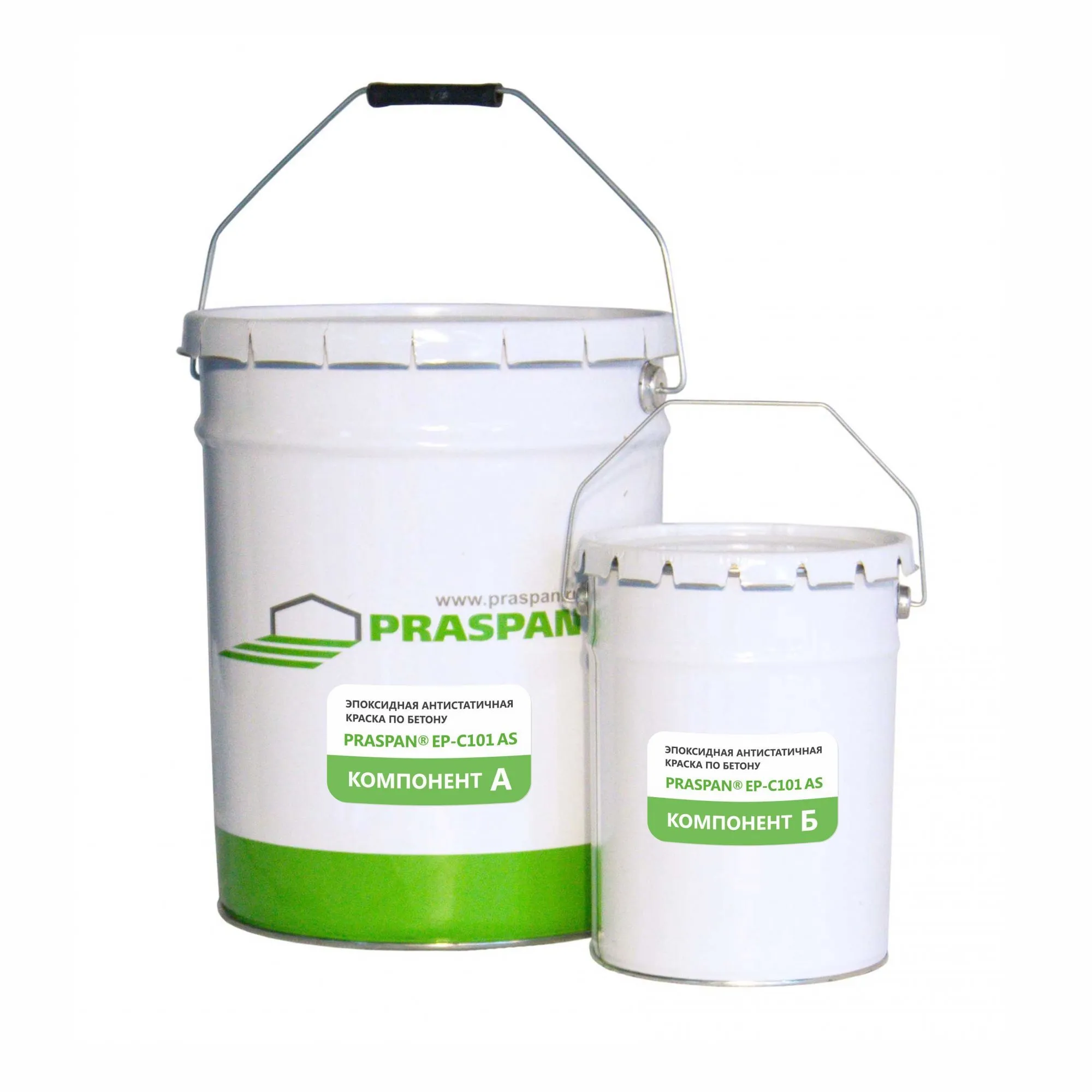
Praspan® EP-C101 AS is an epoxy conductive colored glossy floor paint for concrete.
The paint is used as a topcoat to create a thin-layer coating on concrete floors subjected to medium abrasive loads, as well as medium and moderately heavy static and dynamic loads: warehouses, industrial facilities, garages, etc. Antistatic coatings are among the most in-demand solutions on the market. Such materials must meet specific requirements, including a defined level of electrical conductivity. Conductivity is usually characterized by surface resistivity, which should be in the range from 106 to 108 Ω.
Key properties:
- good mechanical performance, aesthetic appearance and high elasticity allow the coating to be used in a very wide range of facilities;
- no odor during and after application;
- excellent conductive properties (surface resistivity up to 108 Ω);
- economic consumption due to high flowability of the material;
- UV resistant;
- simple and convenient application, which makes this material attractive for any customer;
- the material can also be applied to metal, provided the surface is properly prepared.
Praspan® EP-C101 AS coating is based on epoxy resin; its main components are epoxy resin, modifiers, pigments, an antistatic additive and a hardener in varying proportions.
Praspan® EP-C101 AS kit composition:
- topcoat component — 26,3 kg;
- hardener — 3,7 kg.
Kit mass: 30,0 kg.
The material is an opaque viscous liquid without foreign inclusions. Filler sedimentation is possible.
The paint is applied to a properly prepared dry concrete substrate (without priming). Before application, the substrate must be prepared and all contamination removed, such as laitance, stains of fuels and lubricants, rubber marks, fillers, paints, etc. Surface preparation should be carried out using grinding or abrasive machines, or shot-blasting or sandblasting equipment.
Surface appearance: glossy.
Material consumption:
- first coat — average paint consumption on a dry concrete substrate is 0,2–0,3 kg/m²;
- subsequent coats — recommended consumption for the second and following coats is 0,1–0,2 kg/m²;
- recommended total consumption — 0,5–0,6 kg/m² (2–3 coats).
Maximum recommended number of coats: 4.
Crystallization of epoxy-resin-based materials
All produced materials (topcoats, primers, paints) that contain epoxy resins can harden (crystallize) during transportation or storage at subzero temperatures or under temperature fluctuations.
Crystallization is partial or complete solidification of the material. This is a normal phenomenon that does not degrade the epoxy resin and does not affect the material properties.
To decrystallize the material, it must be kept at a temperature of 40°C to 60°C for at least 2–3 hours. Since the decrystallization process at the job site is often difficult or impossible, it is strongly recommended to store and transport all epoxy products at positive temperatures in the range from +5°C to +30°C.