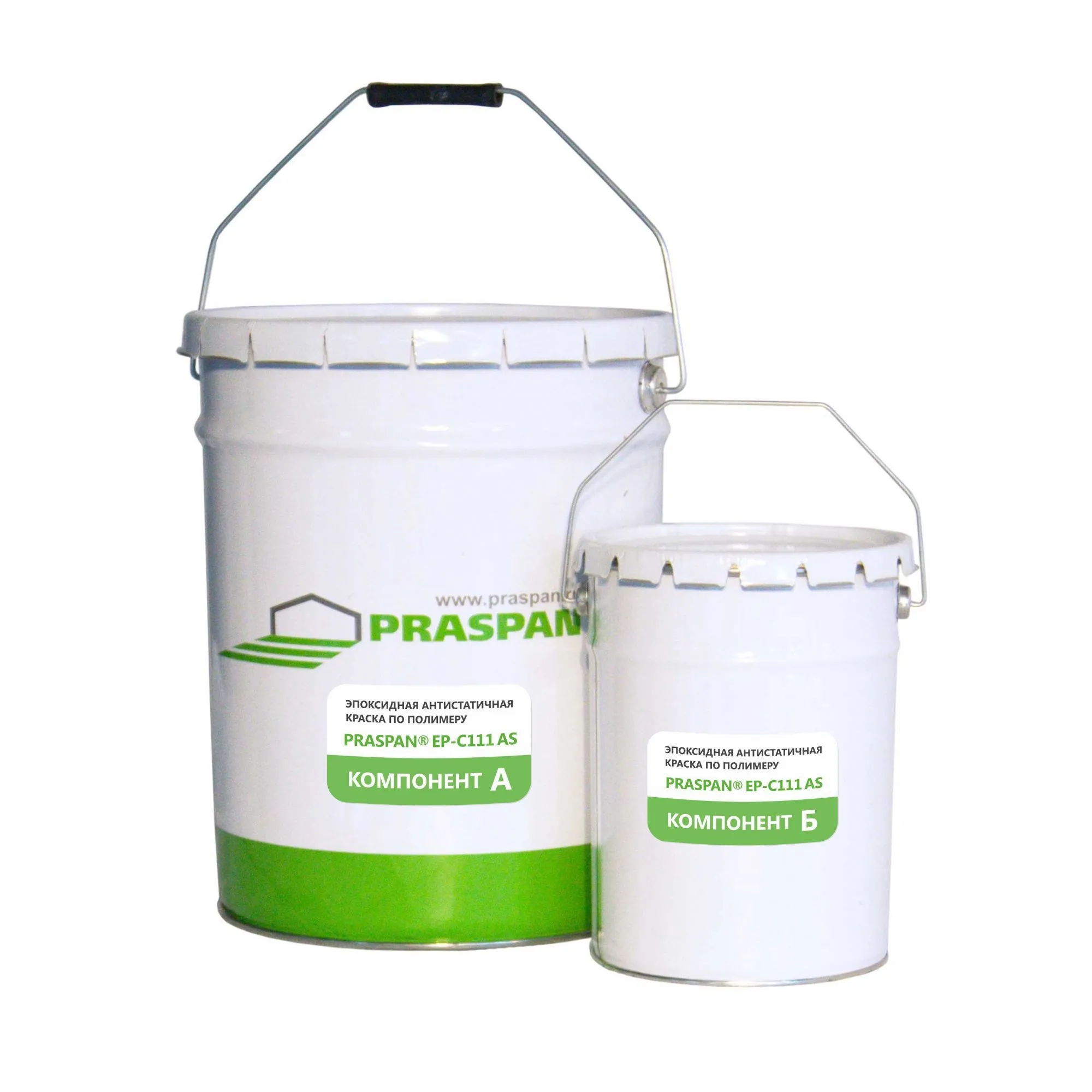
Praspan® EP-C111 AS is an epoxy antistatic colored semi-matte coating for polymer substrates.
Praspan® EP-C111 AS coating is a two-component, thin-layer, conductive colored epoxy system (polymer coating) based on epoxy resin with a special conductive filler for decorative polymer substrates. It does not contain volatile solvents or toxic substances.
Praspan® EP-C111 AS is used as a topcoat for final thin-layer coatings on polymer substrates subjected to medium abrasive loads as well as medium and moderately heavy static and dynamic loads.
Key properties:
- excellent conductive properties — surface resistivity up to 107 Ω;
- cost efficiency — low application cost per 1 m²;
- does not contain volatile solvents (odorless) or toxic substances;
- low substrate preparation requirements before application — a level, clean, pore-free polymer surface;
- allows restoration of old antistatic coatings or installation of new ones on a wide range of polymer substrates;
- simple and convenient application — only one material is needed to create an antistatic coating, and application is fast and easy;
- the coating is easy to renew (restore) — it is sufficient to apply a new coat over the previous one; this can be done even after several years of service;
- effective starting from a single coat.
Praspan® EP-C111 AS kit composition:
- topcoat component — 26,3 kg;
- hardener — 3,7 kg.
Kit mass: 30,0 kg.
The material is an opaque viscous liquid without foreign inclusions. Filler sedimentation is possible.
Surface appearance: semi-matte.
The paint is applied to a properly prepared dry polymer substrate (free of stains of fuels and lubricants, fillers, paints, rubber marks, etc.). Application to other types of substrates may reduce the conductive properties or completely eliminate the conductivity effect.
Material consumption:
- first coat consumption — 0,2–0,3 kg/m²;
- subsequent coats consumption — 0,1–0,2 kg/m².
Maximum recommended number of coats: 4.
Crystallization of epoxy-resin-based materials
All produced materials (topcoats, primers, paints) that contain epoxy resins can harden (crystallize) during transportation or storage at subzero temperatures or under temperature fluctuations.
Crystallization is partial or complete solidification of the material. This is a normal phenomenon that does not degrade the epoxy resin and does not affect the material properties.
To decrystallize the material, it must be kept at a temperature of 40°C to 60°C for at least 2–3 hours. Since the decrystallization process at the job site is often difficult or impossible, it is strongly recommended to store and transport all epoxy products at positive temperatures in the range from +5°C to +30°C.