 LBC Industrial Floor · materials for industrial floors
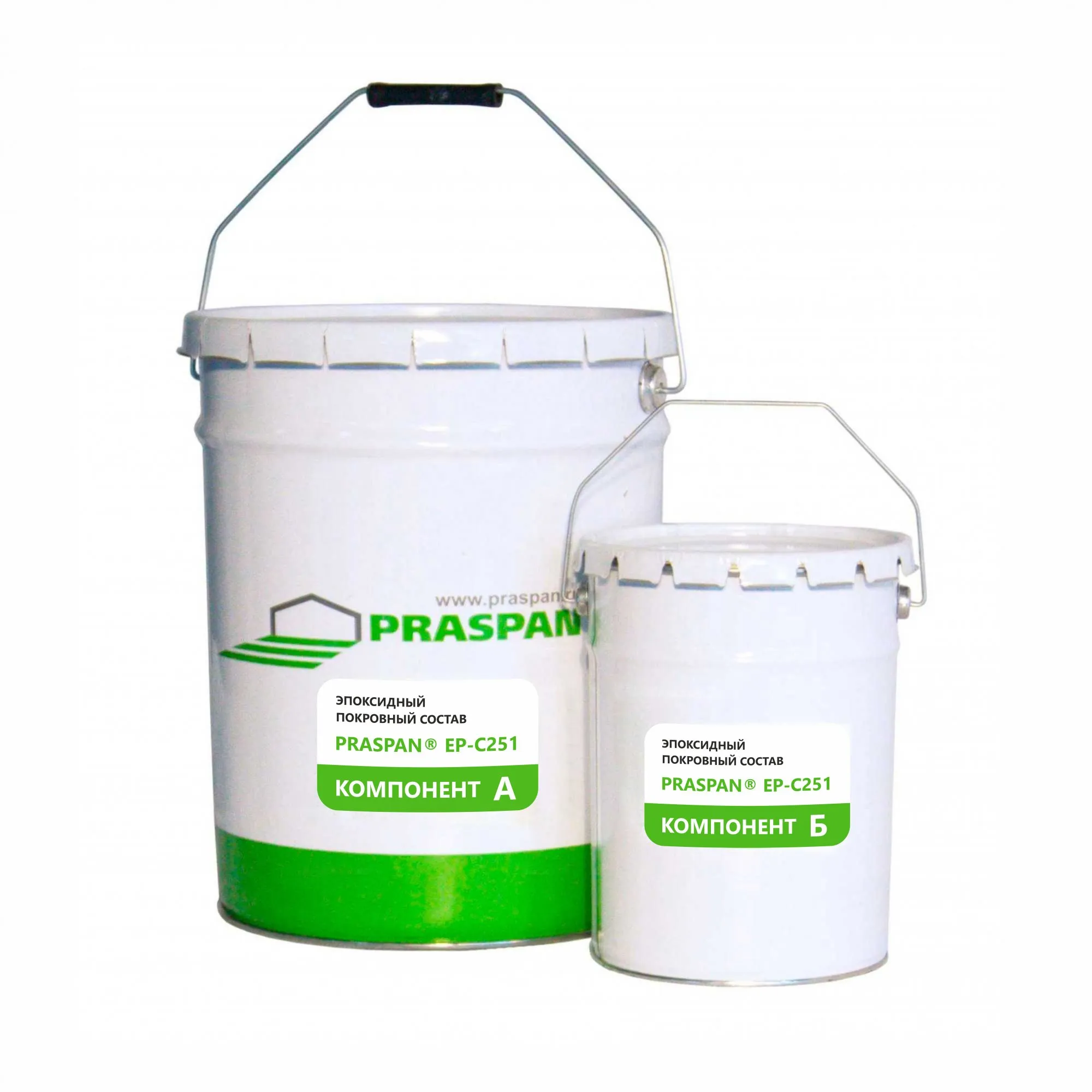
Epoxy topcoat PRASPAN® EP-C251
Praspan® EP-C251 epoxy topcoat is a two-component self-leveling, highly flowable, glossy colored epoxy system without volatile solvents for self-leveling polymer floor coatings.
Get product selection and project estimate
Warehouse in Tashkent, Muynakskaya St., 135. Shipping across Uzbekistan and Tajikistan.
Description
Praspan® EP-C251 is a two-component self-leveling, highly flowable, glossy colored epoxy system without volatile solvents for self-leveling polymer floor coatings.
The material is a colored opaque viscous liquid without foreign inclusions. Sedimentation of the filler is possible.
Praspan® EP-C251 topcoat is used as a finishing material in epoxy floor coating systems under medium and heavy abrasive loads. It is well suited for all types of retail, warehouse, automotive repair and industrial facilities. For the best coating quality, the use of the Praspan® EP-C150 base coat is recommended.
Key properties:
- excellent resistance to abrasive loads (for example, intensive traffic);
- good chemical resistance to non-concentrated alkalis and acids;
- does not contain volatile solvents and is odorless during and after application, which is especially important when working in residential areas;
- high flowability simplifies application of the material;
- smooth surface and excellent glossy finish.
The Praspan® EP-C251 kit includes:
- topcoat component – 20.9 kg;
- hardener – 4.1 kg;
- Kit mass – 25 kg.
Crystallization of epoxy-resin-based materials
All produced materials (topcoats, primers, paints) that contain epoxy resins can harden (crystallize) during transportation or storage at subzero temperatures or under temperature fluctuations.
Crystallization is partial or complete solidification of the material. This is a normal phenomenon that does not degrade the epoxy resin and does not affect the material properties.
To decrystallize the material, it must be kept at a temperature of 40°C to 60°C for at least 2–3 hours. Since the decrystallization process at the job site is often difficult or impossible, it is strongly recommended to store and transport all epoxy products at positive temperatures in the range from +5°C to +30°C.
Technical specifications
| Compressive strength (MPa) | min. 68,2 |
| Tensile strength (MPa) | min. 16,3 |
| Coating appearance | glossy |
| Mixture density at 20°C | 1100 kg/m³ |
| Mixture viscosity at 20°C | 2200 mPa·s |
| Working time at 20°C (full kit) | 25–30 minutes |
| Gel time at 20°C on the surface | 60 minutes |
| Gel time at 20°C in volume (in a bucket) | 15 minutes |
| Intercoat interval at 20°C, minimum | after 24 hours |
| Intercoat interval at 20°C, maximum | after 3 days |
| Material consumption per 1 m² | 2,2 kg at 2 mm layer thickness |
| Curing time at 20°C, pedestrian traffic | after 24 hours |
| Curing time at 20°C, light traffic load | after 48 hours |
| Curing time at 20°C, full traffic load | after 72 hours |
| Chemical resistance to water | resistant |
| Chemical resistance to fuels and lubricants | resistant |
| Chemical resistance to dilute acids | resistant |
| Chemical resistance to dilute alkalis | resistant |
| Shore hardness (type D) after 7 days | 82 units |
| Taber abrasion*, not more than | 30 mg per 1000 cycles (*tests carried out with CS10 abrasive wheels, 1000 g load) |
| Spark generation | does not produce sparks |
Documents
Product technical documentation.
-
PRASPAN® ЕР-С251_19.08.25
PDF · 3.8 MB
-
1. Сертификат соответствия.
PDF · 8.5 MB
-
2. Пожарный сертификат.
PDF · 8.3 MB
-
Санитарное заключение_покрытие полимерное_PRASPAN
PDF · 2.2 MB