 LBC Industrial Floor · materials for industrial floors
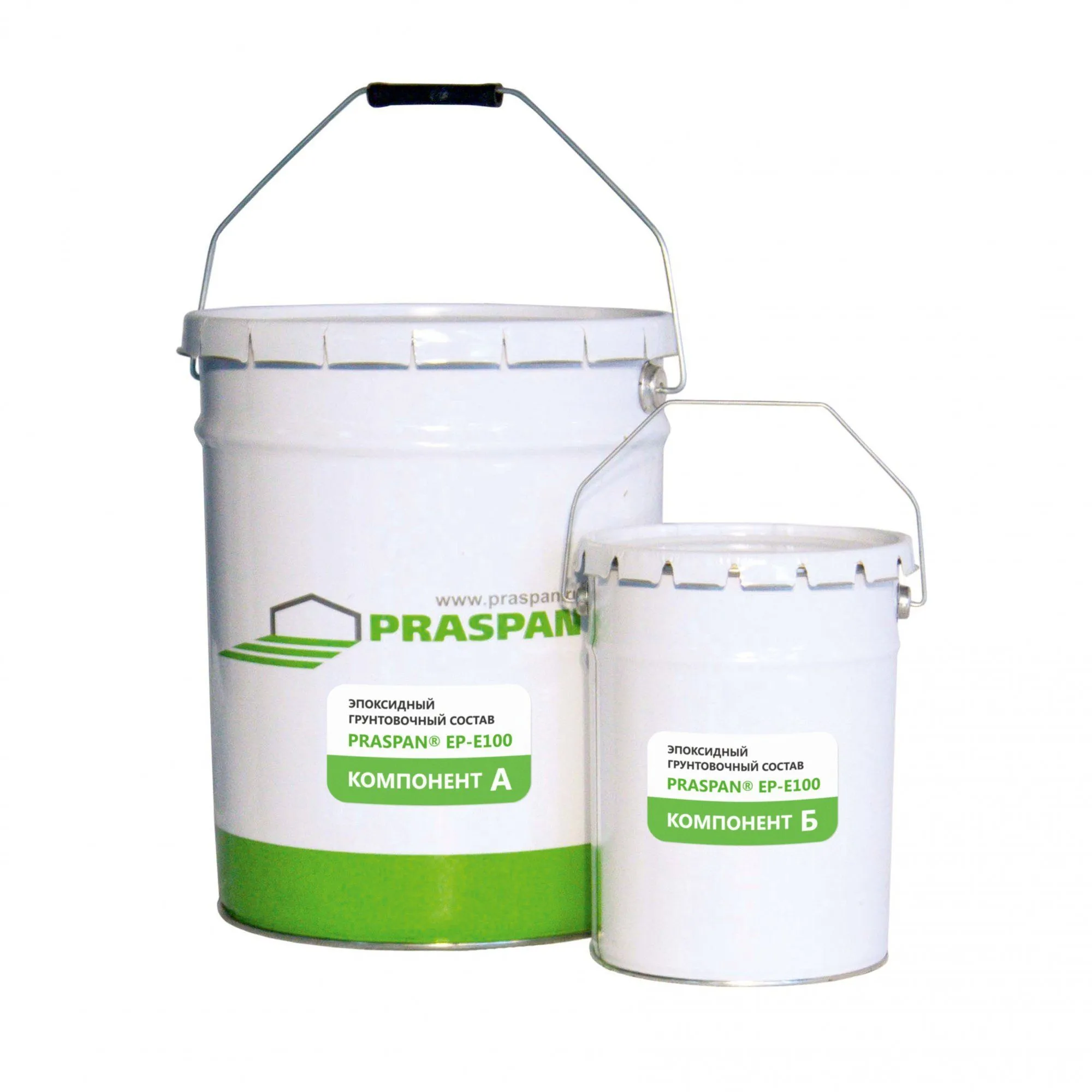
Epoxy antistatic primer PRASPAN® EP-E100
Praspan® EP-E100 is a two-component epoxy electrostatic dissipative primer without volatile solvents for dry concrete substrates.
Get product selection and project estimate
Warehouse in Tashkent, Muynakskaya St., 135. Shipping across Uzbekistan and Tajikistan.
Description
Praspan® EP-E100 is a two-component epoxy electrostatic dissipative primer system without volatile solvents for dry concrete substrates.
It is used to create an electrostatic dissipative thin-layer coating with high physical and chemical performance. It is applied in thin-layer, monolithic and highly filled coatings on concrete substrates in industrial, commercial, residential and public buildings and facilities with stationary electrical equipment.
Key properties:
- high electrical conductivity;
- high adhesion to the substrate;
- resistance to saponification;
- rapid strength development;
- good compatibility with other primer systems.
The Praspan® EP-E100 primer consists of an epoxy resin, compatible chemical additives, a hardener and an electrically conductive filler.
The material is a homogeneous black liquid without foreign inclusions.
Technical specifications
| Coating appearance | matte |
| Mixture density at 20°C | 1000–1100 kg/m³ |
| Mixture viscosity at 20°C | 5000 mPa·s |
| Gel time at 20°C on the surface | 60 minutes |
| Gel time at 20°C in volume (in a bucket) | 15 minutes |
| Intercoat interval at 20°C, minimum | 24 hours |
| Intercoat interval at 20°C, maximum | 36 hours |
| Resistance to earth (EN 1081) | 10^3–10^4 Ω |
| Material consumption per 1 m² | 0,1 kg |
| Curing time at 20°C, pedestrian traffic | 24 hours |
| Curing time at 20°C, light traffic load | 2 days |
| Curing time at 20°C, full traffic load | 3 days |
Documents
Product technical documentation.
-
PRASPAN® EP-E100_03.08.23
PDF · 2.2 MB
-
1. Сертификат соответствия
PDF · 8.5 MB
-
2. Пожарный сертификат
PDF · 8.3 MB
-
Санитарное заключение_покрытие полимерное_PRASPAN
PDF · 2.2 MB