 LBC Industrial Floor · materials for industrial floors
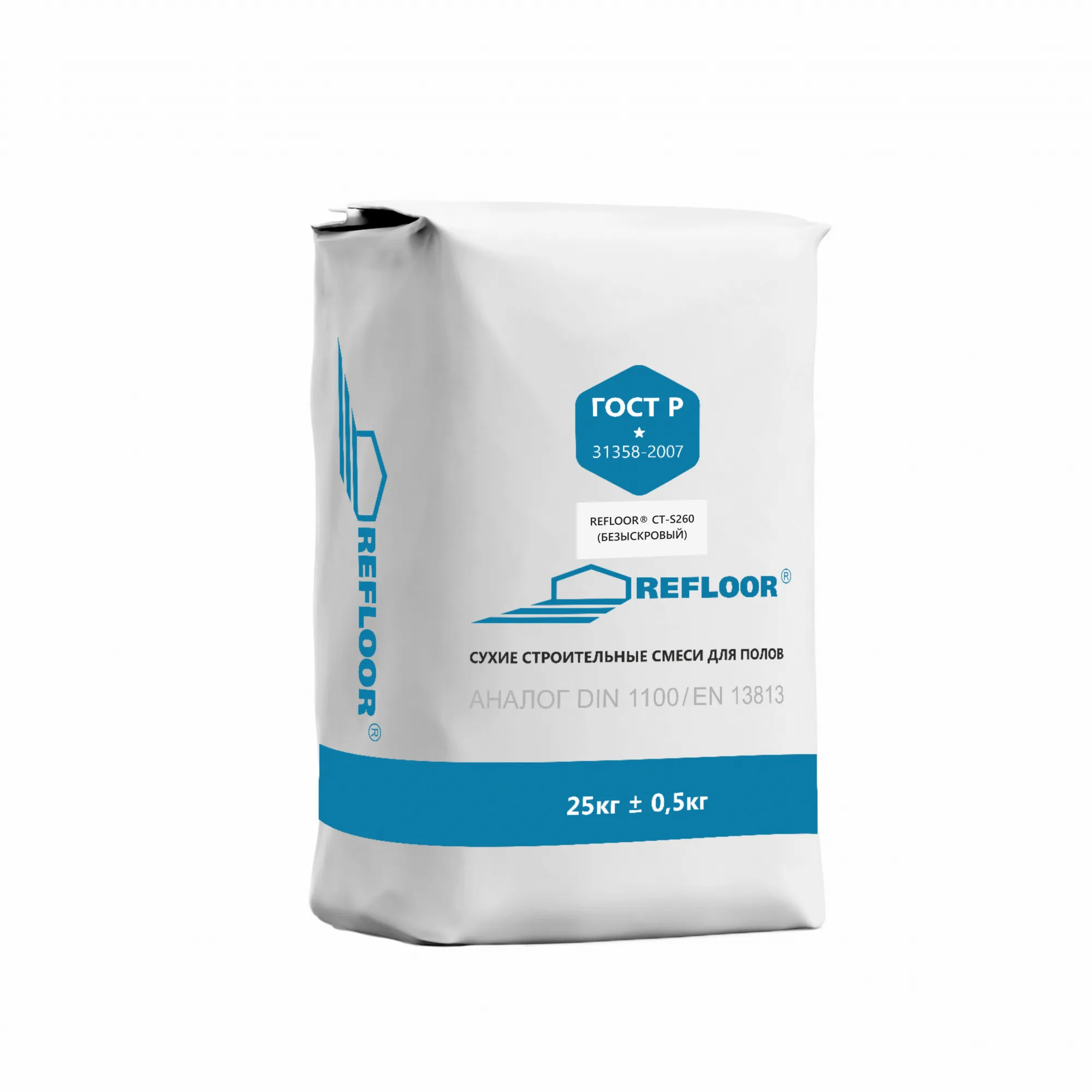
Refloor® CT-S260 is a non-sparking dry single-component cement-based compound for hardening concrete floor surfaces.
Get product selection and project estimate
Warehouse in Tashkent, Muynakskaya St., 135. Shipping across Uzbekistan and Tajikistan.
Refloor® CT-S260 is a non-sparking dry single-component cement-based compound for hardening concrete floor surfaces. The technical characteristics of the material comply with GOST 31358-2007.
This dry shake topping is used as a hardening material for concrete floor coverings in facilities with high load intensity and strict fire and explosion safety requirements. A floor with an applied Refloor® CT-S260 surface hardener does not generate sparks under impact loads on the surface.
The material is a dry, free-flowing fine-grained mixture. It is supplied in 25 kg bags with original printed design. Pallet weight: 1200 kg (48 bags).
Material consumption: the material is applied in one or two passes at a total consumption of 3–5 kg/m², depending on the service loads. For higher loads, the consumption is 5 kg/m² (2 passes at 2,5 kg/m²). For relatively low loads, the consumption is 3 kg/m² (2 passes at 1,5 kg/m²).
| Strength development period | 28 days |
| Material consumption per 1 m² | 5 kg (depending on service loads) |
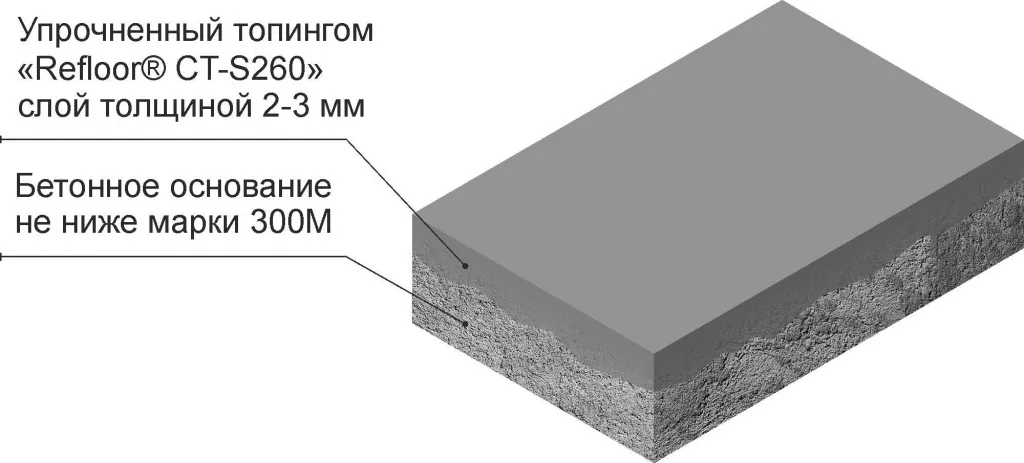
| Layer thickness | 2–3 mm |
| Compressive strength after 28 days | min. 70 MPa |
| Tensile strength after 28 days | min. 7 MPa |
| Bulk density of the mix | 2065 kg/m³ |
| Pedestrian traffic | after 24 hours |
| Maximum aggregate size in dry mix | 3,2 mm |
| Light load (up to 200 kg/cm²) | after 7 days |
| Shrinkage | max. 0,09% |
| Service temperature, short-term exposure | from −60°C to +300°C |
| Abrasion loss on LKI-3M disc | 0,14 g/cm² |
| Impact resistance | 20,0 kg/mm² |
Product technical documentation.
PDF · 3.2 MB
PDF · 949 KB
PDF · 1 MB
PDF · 1.2 MB
PDF · 2 MB
Quick contact
Message us or leave a request — we will respond quickly.