
R slip-resistance class often shows up in specs as: “Set R12 and it will be safe.” In practice, that leads to two extremes: either the floor becomes “sandpaper-like” and can’t be cleaned properly, or someone “wrote an R somewhere,” but people still slip on slopes and in wet areas.
Let’s break down how to choose the R class by zones (dry / wet / greasy / ramps), how to keep the balance cleanability ↔ safety, and which spec phrases most often ruin the outcome.
Contents
1) What the R class is and where it applies
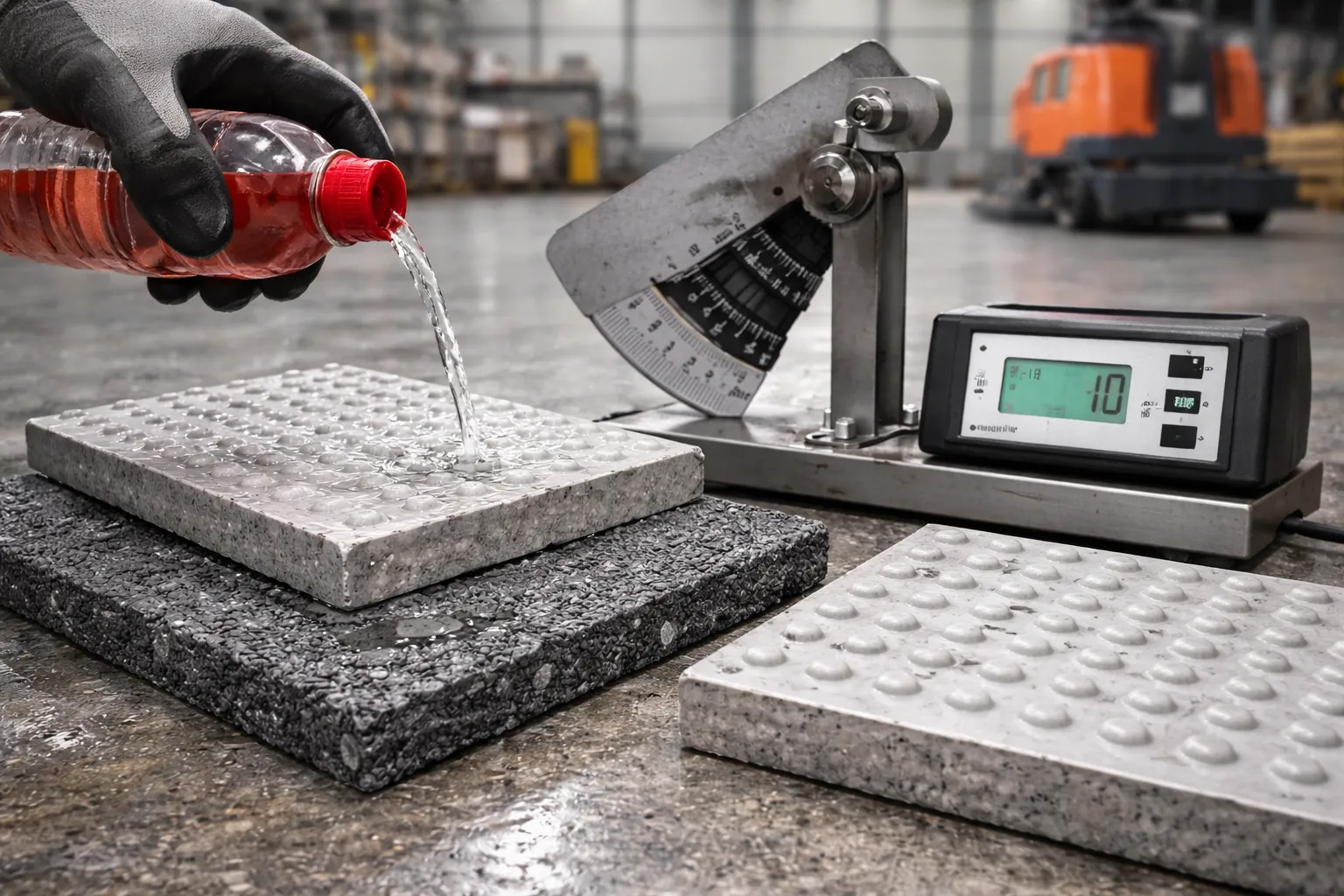
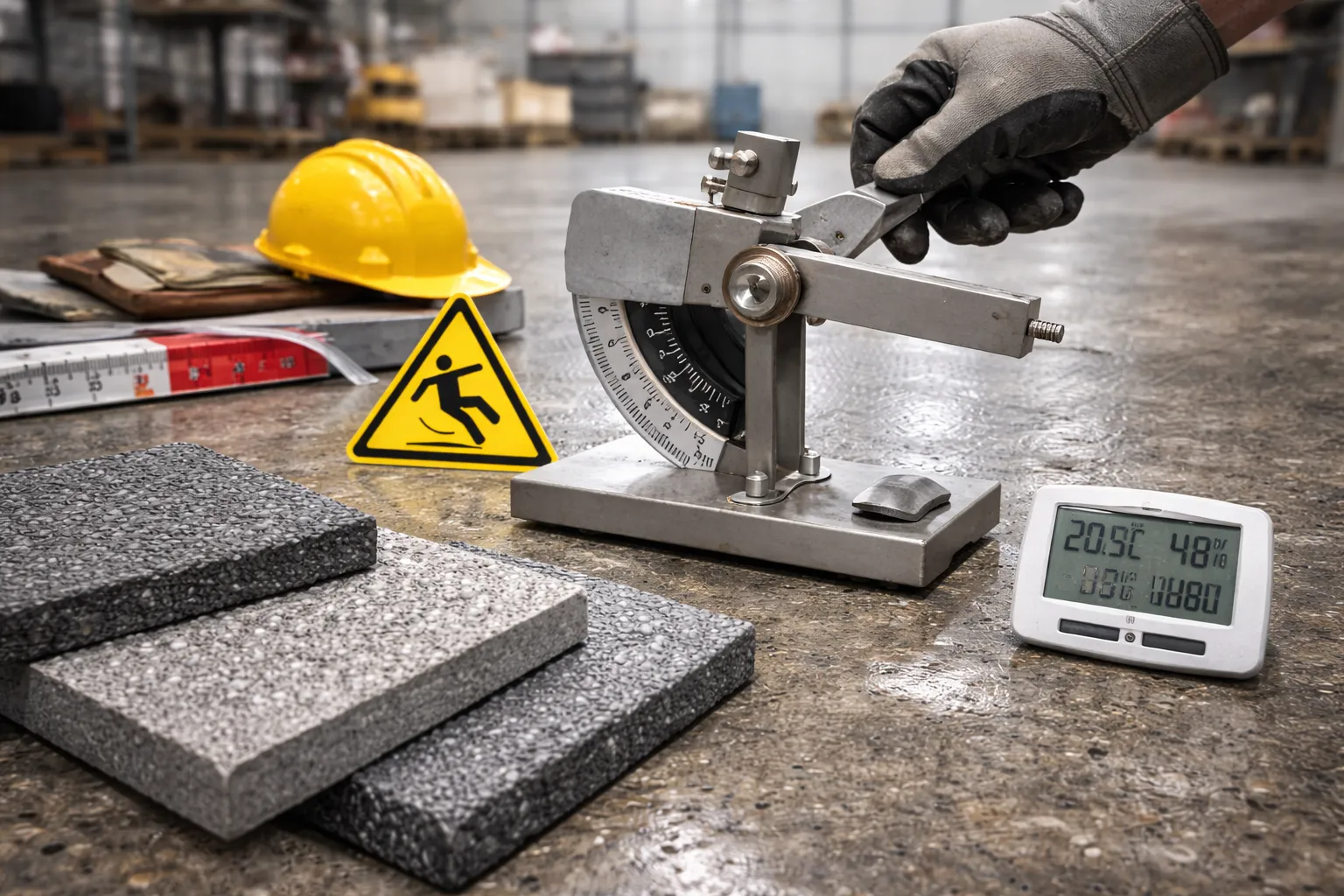
The R class (R9–R13) is a slip-resistance classification for walking in shoes. Testing is done on an inclined plane (ramp): the greater the angle the sample can withstand without slipping, the higher the class.
Important
R is not for “barefoot” areas
For showers, pools, and other wet barefoot zones, a different scale is often used (A/B/C). If you have such areas, make sure to specify that separately.
Nuance
Sometimes R alone isn’t enough
In zones with fats/oils, specs sometimes additionally require “texture volume / drainage” (a V rating/class), so liquids can flow into “pockets” instead of forming a film.
In practice
R is part of a system
The real-world result depends on texture, topcoat type, contamination, slopes, the cleaning regime, and even staff footwear. That’s why a good selection starts with zones and use scenarios.
2) Think in zones: how to quickly assign an R class
The most practical approach is to split the facility into zones. One R class for the whole area is almost always either excessive or insufficient.
| Zone | Conditions | R guidance | Where to go (solutions/systems) |
|---|---|---|---|
| Dry corridors, warehouse aisles | Dry, dust, carts/forklifts | R9–R10 | Epoxy 2–3 mm · Warehouses |
| Wet areas, regular washdown | Water, foam, frequent cleaning, disinfectants | R10–R11 | Food industry · PU-cement 6–9 mm |
| Fats/oils, “slippery film” | Grease, oils, food acids, hard-to-remove contamination | R11–R12 (sometimes +V) | Food industry · Chemical industry |
| Ramps, slopes, entrances/exits | Slope, wet, wheels, braking; in winter—dirt/salt | R12–R13 (locally) | Parking garages · Epoxy R10–R11 (with texture) |
| Chemical areas, spills | Acids/alkalis, reagents, local spills | R10–R12 (depends on cleaning) | Chemical enterprises · PU-cement |
Key point: if a zone is washed frequently and has hygiene requirements, you can’t “over-texture” it. It’s better to specify a moderate R and a proper cleaning regime than to end up with “sandpaper” that traps dirt.
3) The cleanability ↔ safety tradeoff: how to avoid “sandpaper”
Increasing slip resistance almost always increases the surface “micro-relief.” This helps shoes/wheels grip, but at the same time it:
- Makes cleaning harder (dirt and grease hold in the texture; chemical consumption and wash time go up).
- Speeds up wear in forklift turning areas (texture gets “cut off”).
- Reduces hygiene in food/pharma environments: it’s harder to keep clean without aggressive chemicals.
Practical approach
Add slip resistance where it’s needed
- Mark wet/greasy areas and ramps and increase the R class locally.
- Keep a smoother texture in clean walkways—easier cleaning and a neater look.
- If slopes are critical, add strips / “pockets” of anti-slip texture instead of turning the whole floor into sandpaper.
Common mistake
Specifying R12 “for the entire area” without a cleaning scenario
- Cleaning teams can’t keep up, and the floor ends up dirtier than at R10.
- Complaints appear: “hard to clean,” “too rough,” “dust/grease stuck in the texture.”
- Local repairs/recoats become more visible because the texture is hard to replicate.
4) How to achieve the required R class without the sandpaper feel
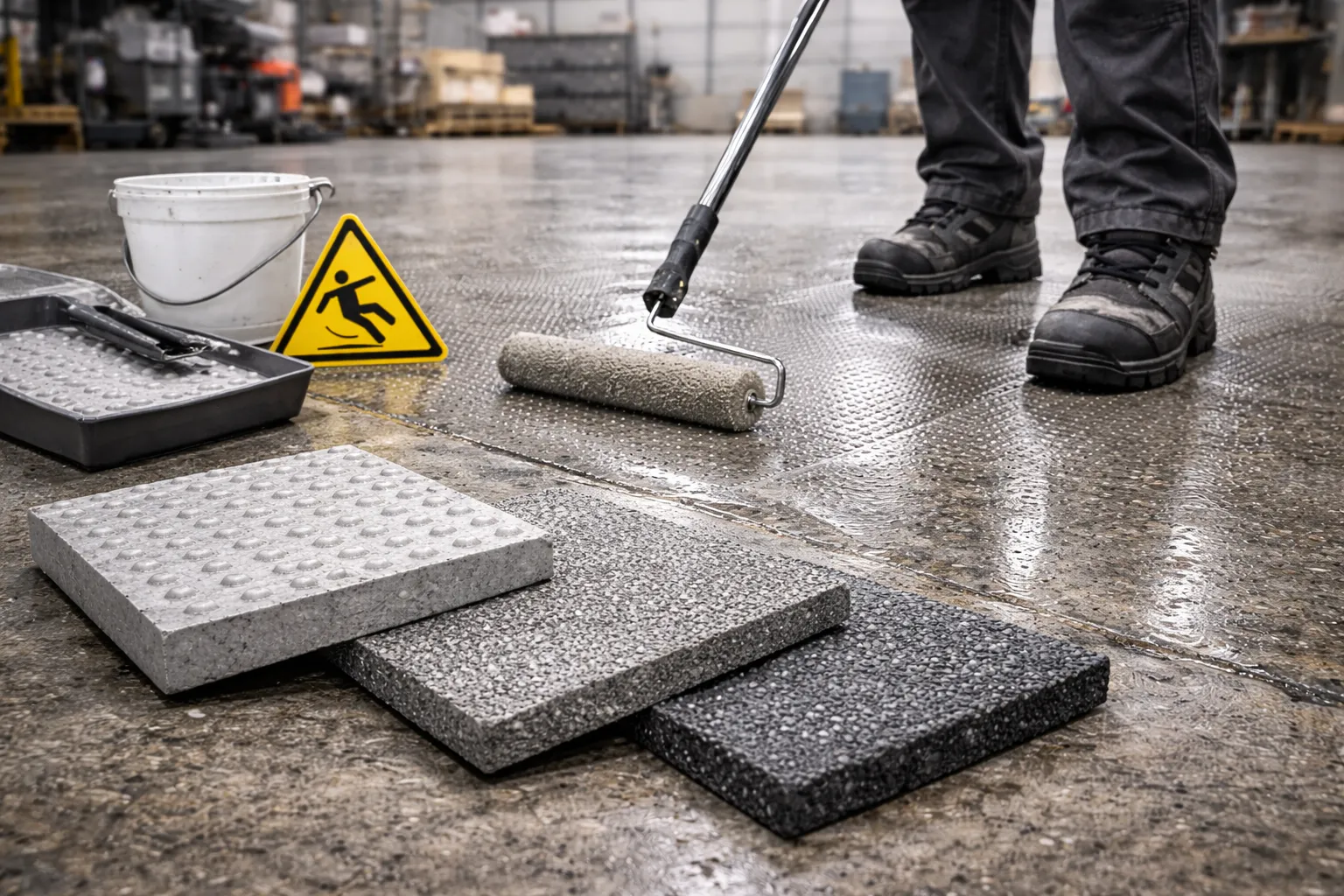
It’s important to understand: the R class is not a “magic property” of resin. It’s achieved through a combination of texture and topcoat. Here are 3 methods that are actually used on real sites:
1) Quartz/corundum broadcast + sealing
Common for R10–R12. The “secret” is that the aggregate is not left exposed—it’s sealed with a finish coat, keeping grip while reducing the abrasive feel.
2) Controlled “orange peel” texture
Texture created by roller/spray gives an even micro-relief. Works well where you need both grip and cleanability (R10–R11).
3) PU-cement with a trowel finish
For food production, hot washdown, and thermal shock. It can provide a “working” R level without aggressive abrasives, while still handling chemicals and temperature.
5) Common spec mistakes and a wording template
Mistake
“Slip resistance R12 for the entire area”
Without zoning and without describing cleaning, this almost guarantees a “sandpaper” surface and operational conflicts.
Better
“R by zones + cleaning method + slopes”
Describe where it’s wet/greasy, where there are slopes, what cleaning looks like and which chemicals are used— and you get a predictable result.
Mini template for a spec (copy/paste):
- Zones: dry walkways / wet washdown / greasy areas / ramps & slopes (specify slope %).
- Required R: R10 in dry zones, R11 in wet zones, R12–R13 on ramps (mark on the plan).
- Cleaning: dry/wet, pressure washing, frequency, detergents/disinfectants.
- Loads: wheel type, turning, racking, impact loads.
- Roughness limitation: the surface must remain cleanable (no “sandpaper”); local texture is allowed in high-risk zones.
If you want an engineer to quickly propose the right recommendation and a zoning scheme, fill in the questionnaire: /brief. We’ll select a solution for your industry: food industry, parking garages, chemicals — and propose a suitable system.
Need an R-class recommendation for your site?
Send a zoning plan and a brief description of your cleaning routine—we’ll suggest a coating system and explain where you need higher R, and where it’s better to keep the surface smoother for hygiene and maintenance.